
8th Sept 2026
Working at height is one of the most common activities on an event site. It is also one of the highest-risk.
We’ve both sadly had to deal with working at height accidents during our careers, and the consequences can be serious.
One of the most important things for event organisers to understand is that working at height doesn’t just mean somebody climbing onto a large stage roof.
Across events, people work at height every day, often without giving it much thought.
What Counts as Working at Height at an Event?
Working at height can include working from or around:
Ladders and stepladders
Mobile access towers
Loading docks
Stage decks
Rigging platforms
Temporary structures
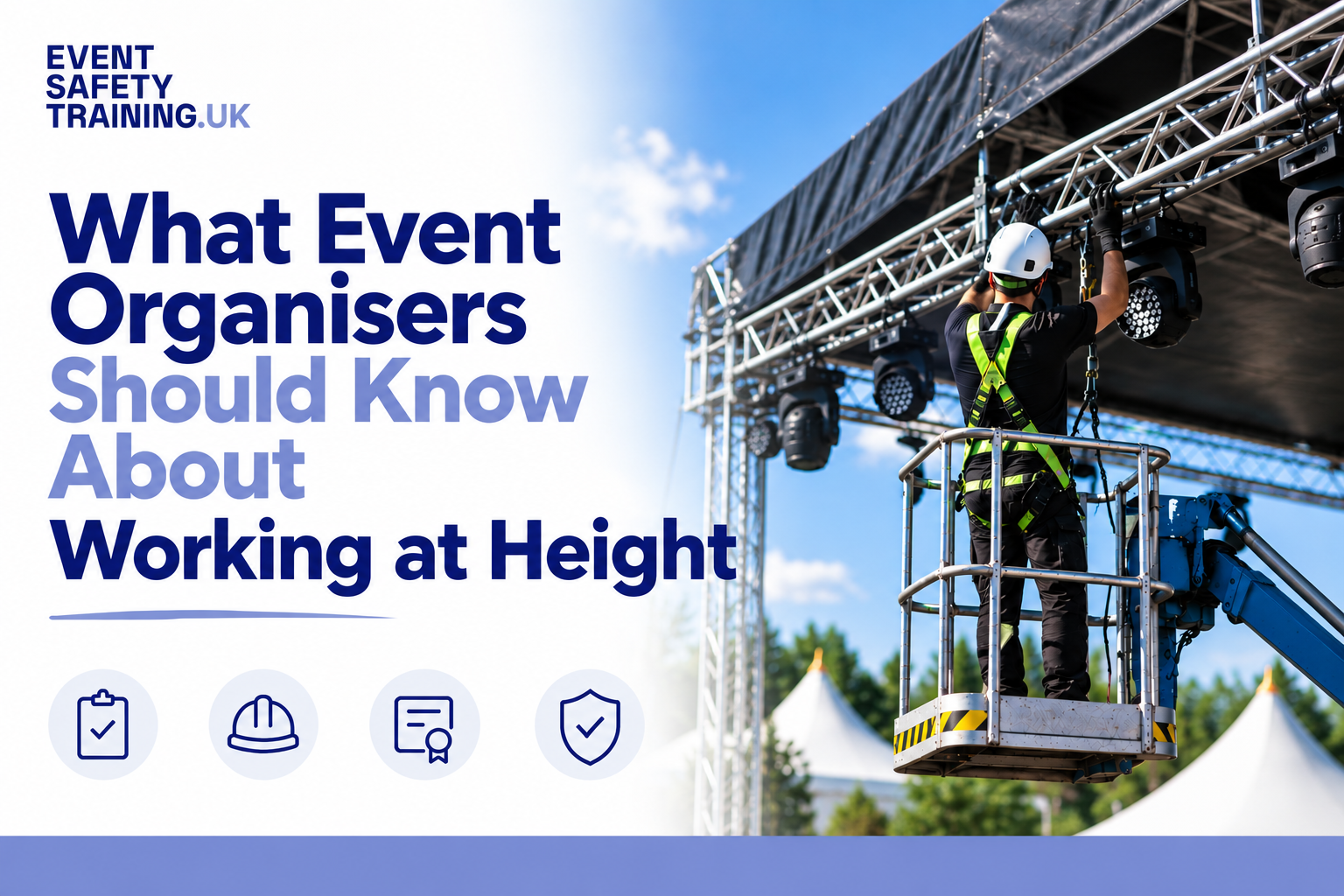
Mobile Elevated Work Platforms (MEWPs)
It can also include situations where someone could fall from one level to another and suffer an injury.
Because these activities are so common during event build, operation and breakdown, it is easy for teams to become comfortable with them.
And that can be a problem.
Working at Height Safety Starts Before Anyone Leaves the Ground
Many working at height incidents don't begin with somebody making a mistake while they are already at height.
The conditions that lead to an accident are often created much earlier.
Common contributing factors include:
Rushed event schedules
Poor access planning
Incorrect equipment
Pressure to complete the build quickly
Inadequate supervision
Fatigue and long working hours
Unsafe shortcuts
This is why planning work at height should form part of the wider event safety and risk assessment process.
Before the task starts, consider what needs to be done, who will be doing it, what equipment they need and how the work can be completed safely.
Not All Access Equipment Is Suitable for Every Task
One of the most common examples on event sites is the use of ladders.
Ladders can be perfectly appropriate for some tasks.
But they aren't appropriate for everything.
For longer-duration, more complex or higher-risk work, equipment such as a mobile access tower or MEWP may provide a safer solution.
Rather than automatically using whatever equipment happens to be available, ask:
"What is the safest reasonable way to complete this task?"
The answer should consider the nature and duration of the work, the height involved, the environment and the equipment or materials the person needs to use.
Weather Can Change the Risk of Working at Height
Outdoor events introduce another significant variable: the weather.
Conditions can change rapidly during an event build or breakdown.
Rain can make working surfaces slippery. Strong winds can affect people, equipment and temporary structures. Poor visibility can make access and movement more difficult.
A task that was safe earlier in the day may no longer be safe several hours later.
This is why working at height arrangements should be reassessed when weather conditions change significantly.
Having a risk assessment doesn't mean the assessment stops once work begins.
Remember the People Working Below
Working at height doesn't only create risks for the person doing the work.
It can also create significant risks for everybody below.
Tools, equipment and materials can fall. Plant and access equipment may be moving. Other contractors may unknowingly enter the area underneath the work.
Effective controls can include:
Appropriate exclusion zones
Good contractor coordination
Clear communication
Effective supervision
Managing access beneath work areas
Securing tools and equipment where necessary
On busy event sites, this coordination becomes particularly important because multiple contractors are often working simultaneously.
Why Do Working at Height Incidents Happen?
Most working at height accidents are preventable.
They are also rarely the result of one dramatic failure.
More often, several smaller problems combine.
Someone is tired. The schedule is running behind. The correct equipment isn't immediately available. Communication isn't clear. A shortcut suddenly looks like the quickest solution.
Individually, each issue might appear relatively minor.
Together, they can create the conditions for a serious accident.
Create a Culture Where People Can Stop
One of the strongest indicators of a good event safety culture is whether people feel able to stop a task when something doesn't look or feel right.
If the correct equipment isn't available, wait.
If weather conditions have changed, reassess.
If an exclusion zone isn't working, fix it.
If somebody is being pressured to complete a task unsafely, slow the process down.
The safest event sites aren't necessarily the ones where everything goes perfectly to plan.
They're the ones where teams recognise when circumstances have changed and are prepared to respond.
Want to Improve Your Event Safety Knowledge?
Working at height is just one of the many risks event professionals need to understand and manage during event build, operation and breakdown.
Our IOSH-accredited event safety courses are designed to provide practical safety knowledge that can be applied directly to real event environments.
If you organise, manage or supervise events and want to develop your understanding of practical event safety, take a look at our upcoming courses and book your place.
Good event safety starts with being curious, asking questions and being prepared to slow things down when something isn't right.
Best regards,